How Mightybytes Turns Digital Work into Climate Action
April 6, 2026
Across the B Corp community, companies are taking action on some of today’s most pressing challenges, advancing progress in specific Impact Topics, from climate action to equity and governance. For Mightybytes, that focus is climate action, and more specifically, the often-overlooked environmental impact of the internet itself.
For more than 25 years, Mightybytes has helped organizations solve complex digital challenges by designing websites, shaping marketing strategies, and building online experiences that drive meaningful results. But beneath the surface of that work is something more intentional: a commitment to making the internet itself more sustainable.
At a time when the environmental impact of digital products is growing, Mightybytes is working to measure, reduce, and rethink what responsible digital work looks like. As a Certified B Corp, that commitment isn’t just aspirational, it’s operational.
Measuring What Most Companies Overlook
For many businesses, emissions tracking focuses on what’s tangible, including offices, energy use, and travel. But for a digital agency, much of the impact happens in places that are harder to see, such as servers, data transfers, and the infrastructure behind every website and app. Mightybytes has made it a priority to measure that impact.
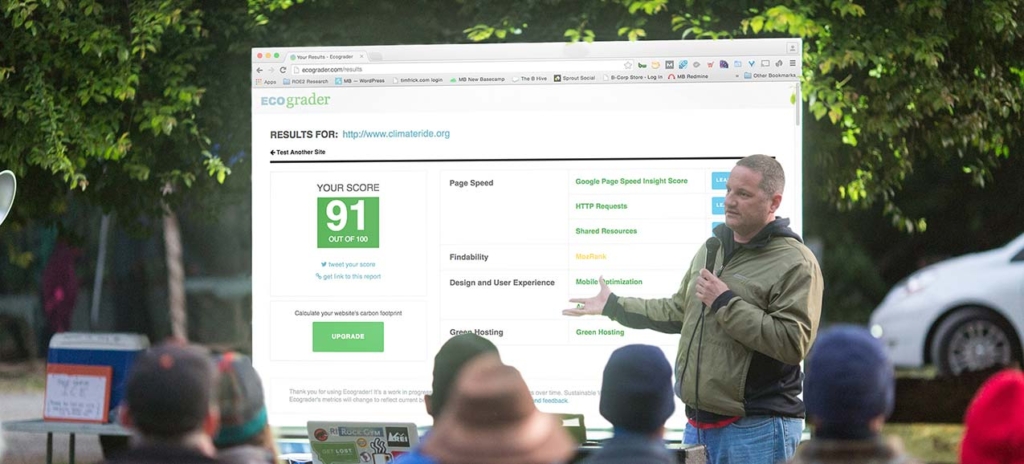
Using tools like the Sustainable Web Design model, along with SME Climate Hub resources for operational emissions, the team is building a clearer picture of both their direct footprint and the digital emissions tied to client work. They also developed Ecograder, a tool designed to evaluate the environmental impact of websites and generate sustainability reports, helping address a long-standing gap in accessible data.
“Writing the plan itself was easy… it was getting to this point… which has been a long journey,” says Tim Frick, Founder and President.
That journey spans more than a decade of experimentation, education, and industry collaboration, from publishing resources on sustainable design to contributing to global standards like the Web Sustainability Guidelines.
What began as a series of incremental efforts has now evolved into a formal climate action plan—one that brings structure, accountability, and clarity to work they’ve been building toward for years.
Climate Action Impact Topic in Practice Guide
This guide from B Lab U.S. & Canada provides examples and resources from B Corps and partners to support companies in meeting requirements in the new Climate Action Impact Topic.
Turning Commitments into Measurable Action
Mightybytes’s climate action plan centers on four key areas, including measuring emissions, reducing impact, offsetting what can’t yet be eliminated, and sharing knowledge to drive broader change.
They are rethinking everything from business travel to supplier relationships, prioritizing partners who share their climate commitments and looking for opportunities to reduce impact across their ecosystem. At the same time, they are working to decrease reliance on offsets and renewable energy credits over time, focusing instead on meaningful, sustained emissions reductions.
Their approach is guided by the SMARTIE framework, which ensures that goals are not only strategic and measurable, but also inclusive and equitable. It’s a reminder that climate action isn’t just about carbon. It’s about systems, accountability, and long-term impact.
Designing for People and the Planet
For Mightybytes, sustainability doesn’t exist in isolation. It’s deeply connected to accessibility, ethics, and user experience. By creating more inclusive digital products, they also improve performance. Faster, more efficient websites require less energy, reducing both costs and environmental impact.
This intersection of accessibility and sustainability is central to their philosophy that better digital experiences can benefit both people and the planet.
“Mightybytes’s leadership is really spot on with walking the talk… Our team is very optimistic about trying to make an impact where we can, and hopefully that has ripple effects,” says Tracy Schneider Gerwen, Digital Project Manager.
That optimism shows up not just in their client work, but in the resources they’ve created, from ethical marketing guidance to tools that help organizations evaluate and improve their digital supply chains.
Meeting Clients Where They Are
For many organizations, sustainability still competes with more immediate concerns like revenue, traffic, and performance. When those pressures mount, long-term initiatives can fall to the bottom of the list. Mightybytes has learned to navigate this by reframing the conversation.
Instead of positioning sustainability as an added responsibility, they connect it to outcomes businesses already care about, such as faster websites, lower hosting costs, better performance, and improved user experience. By embedding sustainability into existing workflows, through workshops, reporting, and ongoing client conversations, they make it more accessible and actionable.
At the same time, they continue to introduce new ideas that may not yet be on their clients’ radar, helping expand awareness of issues like digital energy use and responsible technology practices.
Navigating a Rapidly Evolving Landscape
The broader digital ecosystem is changing quickly, and not always in ways that support sustainability. The rise of AI, for example, brings both opportunity and risk. While it can drive efficiency, it also requires significant energy and water resources, with impacts that are still not fully understood or measured.
At the same time, increasing reliance on automation and algorithm-driven platforms has contributed to what some describe as the “enshittification” of digital experiences, where quality declines as platforms prioritize profit and attention over user well-being.
Mightybytes is actively navigating these shifts. Through responsible AI policies and a focus on ethical marketing practices, they aim to help clients adapt without compromising their values. This includes pushing back against tactics such as misinformation, accessibility shortcuts, or attention-driven content strategies that may deliver short-term gains but cause long-term harm.
Building a Model for the Future
Internally, Mightybytes’s climate action plan serves as a roadmap to help the team refine processes, improve measurement, and strengthen accountability over time. Externally, the goal is broader, to influence how the digital industry approaches sustainability.
“Mightybytes’s Climate Action Plan certainly won’t solve all the problems. However, it will give us a clear and measurable company roadmap to support the change we seek over time,” says Frick.
By sharing their work openly, they are contributing to a growing movement that sees the internet not just as a business tool, but as a system that must be designed responsibly.
Starting Where You Are
For companies just beginning to think about climate action, Mightybytes offers a grounded perspective to start with what’s within your control. Focus on the changes you can make today. Build systems that allow you to improve over time. And share what you learn along the way—even when the path isn’t straightforward.
That transparency, they’ve found, builds trust, strengthens relationships, and creates opportunities for collective progress. Because in a space as complex as climate action, momentum matters.
Want to learn more?
Dive into the full Mightybytes case study to explore their climate action plan, digital sustainability tools, and the strategies they’re using to help shape a more responsible web.
Sign Up for our B The Change Newsletter
Read stories on the B Corp Movement and people using business as a force for good. The B The Change Newsletter is sent weekly.