Redefining Capital: An Intersectional Call to Action for International Women’s Day
March 2, 2026
On International Women’s Day, we celebrate the innovation, resilience, and leadership of women entrepreneurs around the world. But celebration without accountability falls short. One of the most persistent and defining barriers facing women-owned and led businesses is access to capital.
Despite decades of conversation about equity in entrepreneurship, venture capital continues to shape the dominant narrative around growth. Yet women receive only a fraction of venture funding globally, and the numbers are even more stark for women of the Global Majority. The gap is not about a lack of ambition or capability. It is about systems designed to reward familiarity.
As Gayle Jennings O’Byrne, CEO of Wocstar Capital, notes, “Access to capital remains one of the defining barriers for women-led businesses. Venture capital continues to shape the narrative around growth, yet women receive only a small fraction of those dollars… Capital is not only money, it is access to networks, information, and decision-making rooms.”
Her words underscore a critical truth: capital is as much about proximity and power as it is about dollars.
How Bias Shapes the Pursuit of Capital
The traditional venture model is built around pattern recognition. Investors are trained to look for founders who resemble past “wins”. Leadership is often measured against an unspoken archetype that is typically white, male, and backed by elite networks. Pitch norms reward aggressive growth projections, blitzscaling strategies, and founder personas that align with a narrow definition of “visionary.”
Funding decisions, as Jennings O’Byrne explains, are frequently influenced by familiarity. When access depends on closed networks and warm introductions, capable founders are systematically overlooked. Women of the Global Majority often enter rooms where they are underrepresented or absent altogether. The result is a self-perpetuating cycle: capital flows where it has flowed before.
If we are serious about economic justice, we must question not only who gets funded, but how funding decisions are made.
Reimagining What “Capital” Means
Reimagining capital requires expanding our definition beyond venture equity. For many women entrepreneurs, particularly those building community-rooted businesses, sustainability and ownership may matter more than hypergrowth.
Alternative strategies are already reshaping the landscape:
- Revenue-based financing allows founders to repay investors as a percentage of revenue rather than giving up equity.
- Community investment funds that pool resources to invest locally and align returns with shared prosperity.
- Crowdfunding as relational capital, leveraging trust and community support rather than gatekeeper approval.
- Cooperative ownership models, where workers or community members share in governance and wealth creation.
- Rotating savings models, such as tandas and susus, have long enabled communities to self-finance outside traditional banking systems.
- Philanthropic and hybrid capital structures that blend grants, low-interest loans, and equity to reduce risk for early-stage founders.
- Corporate supply chain partnerships that provide guaranteed contracts, distribution, and procurement opportunities, which are forms of access that can be as transformative as a check.
These models recognize that capital is multidimensional. It includes knowledge, relationships, credibility, and ownership. It is not just about raising money, it is about building durable enterprises that create long-term value.
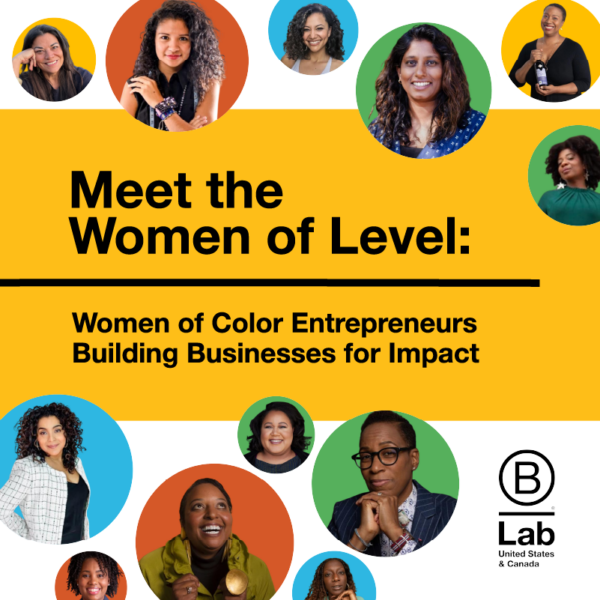
Meet the Women of Level
Learn more about business leaders building a more equitable and just economy in an engaging downloadable resource from B Lab U.S. & Canada.
Addressing the System Head-On
Changing the narrative requires institutions willing to challenge the status quo.
Networks like WeTheChange, a global community of women in the B Corp movement, are advancing collective advocacy for gender equity in business. Through community, policy advocacy, and accountability, they are shifting who has influence and who has access in the B Corp ecosystem. By leveraging their collective voice, members are addressing structural barriers, not just individual outcomes.
“Women-owned businesses continue to be underserved by everyone from venture capital to SBA loans, and options are particularly slim for service businesses,” says Lindsay LaShell, previous Director of Strategic Partnerships at WeTheChange. She added that impact-driven businesses in general are overlooked. “There are no investment vehicles that focus on B Corps, despite studies showing that these businesses are more resilient through tough economic times.”
Programs like Level are also taking direct action by equipping founders with the tools needed to navigate the capital landscape. Level was born from the idea that by working together toward the common goal of investing in women, they can both serve the cause and build authentic cross-racial relationships, leading to a unique and robust multiracial network.
Similarly, Wocstar Capital focuses on capital literacy and strategic positioning, helping founders evaluate venture funding alongside alternative pathways. The goal is not merely to help women raise money, but to ensure they build scalable enterprises with ownership and agency intact.
These efforts represent a shift from charity to structural change. They recognize that the issue is not a pipeline problem; it is a power problem.
An Intersectional Imperative
An intersectional lens makes clear that not all women experience the capital gap in the same way. Women of the Global Majority face compounded barriers tied to race, geography, and generational wealth disparities. Many operate in markets historically excluded from mainstream investment. Others lack inherited networks that make fundraising easier.
Yet these entrepreneurs are often deeply embedded in their communities, building businesses that address real needs such as healthcare access, food systems, education, climate resilience, and so much more. When they are underfunded, entire communities lose opportunity.
International Women’s Day calls us not only to spotlight disparity, but to redefine success. What if growth were measured by community impact and shared wealth? What if capital providers valued long-term stability over short-term exits? What if access to decision-making rooms were distributed more equitably?
As Jennings O’Byrne reminds us, capital is about networks and access. Expanding those rooms—and who gets invited inside—is a matter of economic justice.
The future of entrepreneurship will not be built by replicating yesterday’s patterns. It will be shaped by bold reimagination: of capital, of ownership, and of who is trusted to lead.
On this International Women’s Day, the call is clear. Equity in access to capital is not a women’s issue. It is an economic imperative.
Sign Up for our B The Change Newsletter
Read stories on the B Corp Movement and people using business as a force for good. The B The Change Newsletter is sent weekly.