
The Climate Action Standards, Simplified
December 28, 2025
How companies should measure, plan, and act to keep global warming below 1.5 °C
Climate change is the defining challenge of our time, and business is both a driver of the crisis and a potential force for its repair. B Lab’s Climate Action Impact Topic challenges companies of all sizes to move from intention to implementation — whether that means publishing a public climate action plan and reporting on progress, or, for larger companies, quantifying full emissions inventories, setting credible targets, and developing transition plans aligned with a net-zero future.
The science is clear. Recent years have been the warmest on record, and the world is on track to exceed 2 °C of warming within this century unless emissions fall sharply. To keep warming below 1.5 °C, global greenhouse-gas emissions must decline 45% by 2030 (from 2010 levels) and reach net zero by 2050. The window is closing… and so is the public’s tolerance for delay and greenwashing.
Through these standards, B Lab calls on companies to lead where policy has stalled and to treat climate action as a core business function, not a campaign. For smaller companies, that means setting a public plan and demonstrating progress over time; for larger companies, it means backing commitments with measured results, verified data, and transition pathways that support a just and net-zero future.

Get the Climate Action Impact Topic in Practice Guide
This guide from B Lab U.S. & Canada provides examples and resources from B Corps and partners to support companies in meeting requirements in the new Climate Action Impact Topic.
Overview: The Three Core Climate Action Requirements
Climate Action defines how companies translate global climate goals into operational practice. The standards outline a clear sequence — measure emissions, commit to 1.5 °C and net zero, and demonstrate ongoing progress — scaled by company size, sector footprint, and maturity so that every business contributes in proportion to its influence.
Together, these requirements form a progression of accountability: measure → commit → act. Larger and higher-impact companies face heightened expectations for verification, disclosure, and stakeholder engagement. Smaller enterprises follow a different path: one that recognizes capacity constraints and avoids diverting limited resources into intensive data collection. Their role is to take tangible, meaningful climate actions and report on progress over time, without relying on precise GHG measurement.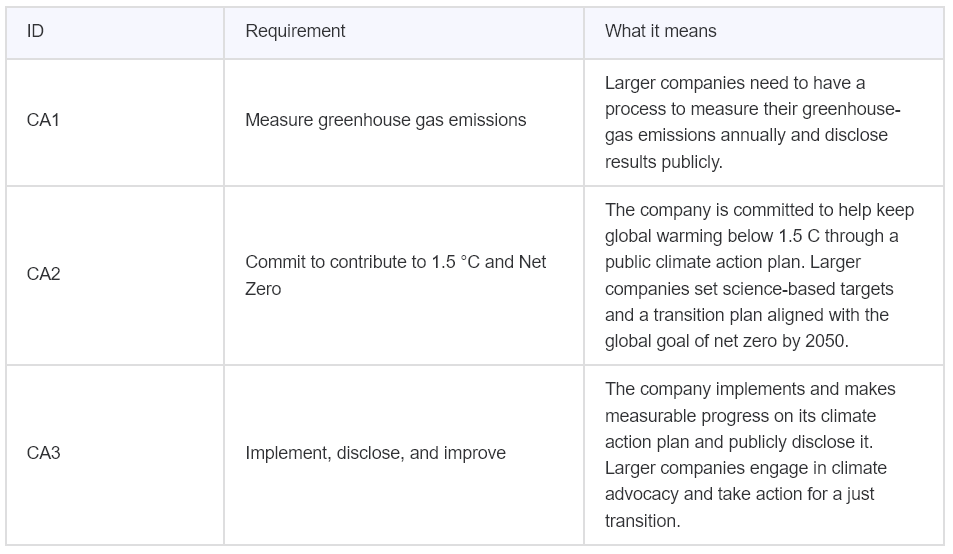
CA1: Measure Greenhouse Gas (GHG) Emissions
Every plan for decarbonization begins with the same step: knowing what you emit. CA1 establishes that baseline. It requires larger companies to measure and disclose their greenhouse-gas emissions annually, creating the factual groundwork for credible targets and lasting reduction.
CA1.1. Measure and Disclose GHG Emissions
Who it applies to: Large, X Large, and XX Large companies (from Year 0)
What’s required:
- Maintain a documented process to measure direct (Scope 1), energy-related (Scope 2), and value-chain (Scope 3) emissions each year
- Use recognized accounting standards such as the GHG Protocol or ISO 14064–1:2018
- Record which Scope 3 categories are included or excluded and explain why
- Disclose total emissions publicly each year, showing both market-based (supplier-specific) and location-based (grid-average) results
Examples of compliance: Using a carbon-accounting platform that follows the GHG Protocol or ISO 14064–1:2018 and generates annual disclosures; working with an accredited consultant to calculate emissions and publish a verified inventory in a public report on the company’s website (e.g., annual report, sustainability report, integrated report). CDP publication may accompany but does not substitute for this requirement.
Why it matters: Measurement is the foundation of climate credibility. Without a clear record of what a company emits, every target is speculation. Public disclosure gives investors, workers, and communities the data to hold companies accountable, and to see whether their strategies are working.
CA1.2. Verify Emissions Through Independent Assurance
Who it applies to: Large, X Large, and XX Large companies (from Year 0)
What’s required:
- Have an accredited, independent third party verify your annual greenhouse-gas emissions data
- Begin verification in the fiscal year prior to certification and repeat it every year thereafter
- Ensure the verification covers direct (Scope 1), energy-related (Scope 2), and all relevant value-chain (Scope 3) emissions
- Confirm that your measurement methods follow accepted standards such as the GHG Protocol or ISO 14064–1:2018
Examples of compliance: Engaging an ISO 14064–3–accredited verifier to audit the full GHG inventory and provide an assurance statement; making that verification letter available in a public report on the company’s website (e.g., sustainability report, annual report) with a clear indication that the inventory has undergone third-party verification.
Why it matters: Independent verification builds trust. It shows that climate data has been tested (not taken on faith), and that a company’s reduction plans rest on facts strong enough to be checked. Reliable data lets leaders make decisions confidently and gives stakeholders proof that progress is real.
CA2: Commit to contribute to 1.5 °C and a Net-Zero future

Measuring impact is the baseline, but responsibility begins with reduction. CA2 sets that expectation: it requires every business to align its goals with the global effort to keep warming below 1.5 °C. Through public plans, science-based targets, and transition strategies backed by resources and oversight, companies move from knowing their impact to owning their path toward net zero.
CA2.1. Publish a Climate Action Plan
Who it applies to: Micro, Small, Medium, and companies without workers (from Year 0)
Smaller companies begin their climate journey here — with a clear, public plan that outlines how they will contribute to the global goal of limiting warming to 1.5 °C. Larger companies meet this same intent later through science-based targets (CA2.2) and transition planning (CA2.3).
What’s required:
- Make a climate action plan publicly accessible — either on your website or, if you don’t have one, through other channels such as digital or printed brochures, information sheets at physical locations, or partner-organization distribution
- Ensure the plan commits to supporting the global ambition to limit warming to 1.5 °C
- Include SMART targets (specific, measurable, achievable, relevant, and time-bound) for performance and impact
- Specify how human, technical, and material resources will be allocated to carry out the plan
- Describe how the company will engage and work with stakeholders
- Ensure the plan is approved by the highest governing body
- Update the plan every 36 months
Examples of compliance: Posting a downloadable “Climate Action Plan” on the company’s website that outlines SMART targets, resource allocation, stakeholder engagement, and includes a note documenting approval by the highest governing body; making printed copies of the plan available at a storefront or office so stakeholders can easily access clear targets, planned actions, and responsible teams; sharing the plan through a chamber of commerce, industry group, or partner-organization newsletter with a stable archive link included on a public-facing page.
Why it matters: A public plan is the first sign of climate accountability. It makes commitments visible to employees, investors, and communities, and turns climate goals from private intentions into shared expectations. For smaller companies, it establishes a foundation that can support deeper voluntary commitments — such as science-based targets or transition plans — if and when the organization chooses to pursue them.
CA2.2. Set Science-Based Targets
Who it applies to: Large, X Large, and XX Large companies (from Year 3)
What’s required:
- Establish GHG reduction targets aligned with a 1.5 °C pathway and the global goal of net zero by 2050
- Have targets validated by the Science Based Targets initiative (SBTi) or verified by an independent, accredited third party
- Include both near-term and long-term (net zero) targets covering Scopes 1, 2, and 3
- Record a clear baseline year and emissions data for each scope, showing how progress will be measured over time
Examples of compliance: Submitting targets to the Science Based Targets initiative (SBTi) and publishing the validation letter on the company’s website; including a one-page performance snapshot in the sustainability report comparing baseline and current emissions for Scopes 1–3.
Why it matters: Science-based targets anchor climate ambition in evidence. They show, numerically and transparently, how much and how quickly a company must decarbonize to stay within planetary limits. Setting these targets turns long-term pledges into measurable commitments, ensuring each company makes a just and proportionate contribution to the global net zero goal.
CA2.3. Develop a Climate Transition Plan
Who it applies to: Large, X Large, and XX Large companies (from Year 3)
What’s required:
- Create a formal, board-approved plan that outlines how the company will meet its near-term and net-zero science-based targets
- Include specific greenhouse-gas mitigation actions, clear roles and responsibilities, and an engagement plan for relevant stakeholders
- Provide a detailed resourcing plan that shows how targets will be funded and implemented
- Disclose the investment made in the last fiscal year to carry out the plan — both the total amount and the percentage of overall capital spend
- Explain how the company’s current or future business model supports achieving net-zero emissions
- Record evidence of credible removals or storage of residual emissions if the company has already reached net zero
Examples of compliance: Releasing a board-approved transition plan that details decarbonization actions, executive ownership, and capital allocation to climate initiatives; featuring a capital-allocation scorecard in the annual report showing total spend on renewable energy, efficiency upgrades, and value-chain engagement.
Why it matters: Targets without plans are promises waiting to fail. A transition plan proves intent by showing where the money, leadership, and responsibility sit. It makes climate action real by embedding it in budgets, jobs, and the design of the business itself.
CA2.4. Consult Workers and Stakeholders for a Just Transition
Who it applies to: Large, X Large, and XX Large companies in high-impact sectors (Wholesale/Retail, Agriculture/Growers, Manufacturing, Service with Significant Environmental Footprint) from Year 3
What’s required:
- Review the company’s climate transition plan to identify which stakeholders may be affected (positively or negatively) and which are most vulnerable to climate impacts
- Engage workers and value-chain partners, including suppliers, to review the plan and provide feedback
- Inform stakeholders about the plan, invite their input, and outline how the company will work with them to implement it
- Integrate feedback into the transition plan, adding concrete “just transition” actions where needed
- Allocate dedicated resources — financial and staff time — and set measurable targets for just-transition actions
Examples of compliance: Hosting workshops with workers and suppliers to identify transition risks and co-design mitigation strategies; collaborating with a social-impact firm to assess worker and community needs and codifying agreed-upon just-transition actions — such as reskilling programs or local resilience grants — into the plan.
CA3: Implement, Disclose, and Improve

The test of a climate strategy isn’t what’s promised; it’s what’s done. CA3 requires companies to operationalize their climate plans: to fund them, govern them, and disclose results in plain sight. Progress must be measured, and improvement must be continuous.
CA3.1. Link Executive Incentives to Climate Performance
Who it applies to: Large, X Large, and XX Large companies in high-impact sectors (Wholesale/Retail, Agriculture/Growers, Manufacturing, Service with Significant Environmental Footprint) from Year 3
What’s required:
- If the company already offers performance-based pay or bonuses for its executive team, integrate climate targets into that incentive scheme
- Determine the incentive scheme through the company’s annual performance evaluation or fiscal review
- Record the value of rewards tied to climate-related performance each year, expressed as a percentage of the executive’s salary
Examples of compliance: Adding a 15–20% weighting for emissions reduction or renewable-energy adoption to executive bonus structures and disclosing it in governance filings; tying long-term incentive pay to progress toward science-based targets and publishing outcomes in the annual sustainability summary or investor update.
Why it matters: When climate results influence compensation, they influence behavior. Linking executive incentives to emissions and transition progress ensures climate commitments are treated as business priorities, not PR statements. It aligns leadership motivation with long-term value creation for people, planet, and shareholders alike.
CA3.2. Engage in Climate Advocacy
Who it applies to: XX Large companies (from Year 3)
What’s required:
- Use advocacy to advance science-based climate policies aligned with the global goal of net-zero emissions by 2050
- Participate in climate advocacy at least once between Year 0 and Year 3, and again between Year 3 and Year 5 — either directly through public-policy engagement or indirectly through trade associations, coalitions, or alliances
- Identify the specific outcomes or policy changes the company aims to influence through its advocacy
- Allocate resources (financial, in-kind, or staff time) to support this work and sustain engagement over time
Examples of compliance: Engaging an industry coalition to align its policy positions with the goal of net-zero by 2050 and disclosing that membership publicly; submitting formal comments to regulators on emissions standards, carbon pricing, or clean-energy incentives; and summarizing priorities and outcomes in an annual advocacy statement.
Why it matters: Climate policy sets the rules for every company’s future. When the largest enterprises use their influence to push for science-based regulation and fair competition, they accelerate the transition for everyone. Advocacy turns private progress into collective momentum.
CA3.3. Make Progress on the Climate Action Plan
Who it applies to: Micro, Small, Medium, and companies without workers (from Year 3)
What’s required:
- Take actions consistent with the latest version of the company’s climate action plan
- Record progress each year, tracking which targets have been met, are in progress, or need adjustment
- Review and update targets as needed to reflect lessons learned or changing circumstances
- If parts of the plan were ineffective, document what was learned, what will change, and how the plan has been updated
Examples of compliance: Maintaining an internal progress tracker reviewed quarterly by leadership; posting a concise annual “Progress at a Glance” update online that highlights performance against KPIs, new initiatives, and lessons learned.
Why it matters: Continuous improvement is the heart of credible climate action. Even smaller companies can lead through iteration: testing, learning, and improving each year. Recording and reflecting on progress turns climate work into an ongoing practice (not a one-time project).
CA3.4. Make Progress on the Climate Transition Plan
Who it applies to: Large, X Large, and XX Large companies (from Year 5)
What’s required:
- Record measurable progress toward near-term and net-zero targets, expressed both in metric tonnes of CO₂ equivalent (CO₂e) and as a percentage of baseline emissions
- Take actions consistent with the latest version of the company’s climate transition plan
- Set new near-term targets at least every 60 months to ensure continuous progress
- Evaluate the effectiveness of the plan and document lessons learned, planned changes, and updates
- Once net zero is achieved, ensure permanent removals of residual emissions, maintain the reductions achieved, and record verified removals or storage across operations and value chains
Examples of compliance: Releasing an audited emissions summary alongside an interactive “Net Zero Dashboard” showing baseline data, reductions achieved, and upcoming milestones; publicly disclosing verified carbon-removal or storage methods once net zero is achieved.
Why it matters: Accountability is measured in tonnes, not talking points. Tracking real reductions — and updating plans when they fall short — keeps ambition grounded in data. Progress toward net zero isn’t a single finish line, but a cycle of action, verification, and improvement.
CA3.5. Take Action for a Just Transition
Who it applies to: Large, X Large, and XX Large companies in high-impact sectors (Wholesale/Retail, Agriculture/Growers, Manufacturing, Service with Significant Environmental Footprint) from Year 5
What’s required:
- Act on the worker and stakeholder feedback gathered under CA2.4, turning commitments into concrete “just transition” initiatives
- Record the actions taken to support a fair and inclusive transition and track their outcomes over time
- Monitor progress to ensure efforts remain effective and responsive to stakeholder needs
Examples of compliance: Launching reskilling programs for workers in phased-out divisions and tracking post-training outcomes; showcasing just-transition results in community reports or employee town halls, such as new green-job placements or local resilience projects.
Why it matters: Transition without justice creates new harms. Acting on consultation ensures that decarbonization strengthens the social fabric around the business. A just transition safeguards both people and performance, building trust, stability, and shared benefit in the move to a low-carbon economy.
CA3.6. Publicly Disclose Progress on the Climate Action Plan
Who it applies to: Micro, Small, Medium, and companies without workers from Year 3
What’s required:
- Report progress against the company’s climate action plan on its website or (if the company has no website) another platform accessible to stakeholders
- Include both performance results (for example, targets met) and the actions taken to achieve them
- Update disclosures regularly to show continued accountability and improvement
Examples of compliance: Adding an annual “Climate Update” page with a clear table of targets, progress, and lessons learned; creating a short snapshot or explainer that summarizes key actions and results in plain language for employees, customers, and community stakeholders.
Why it matters: Reporting progress publicly builds accountability. It lets stakeholders see real outcomes — successes, setbacks, and lessons learned — rather than promises made behind closed doors. For smaller companies, even brief, plain-language updates can build credibility, demonstrating transparency, progress, and a willingness to learn in public.
CA3.7. Publicly Disclose Progress on the Climate Transition Plan
Who it applies to: Large, X Large, and XX Large companies from Year 5
What’s required:
- Publish an annual disclosure on the company’s website detailing progress against the company’s climate transition plan
- Include the full GHG inventory — Scopes 1, 2, and 3 — with both market-based and location-based totals
- Report near-term and net-zero targets and show progress toward each in metric tonnes of CO₂ equivalent (CO₂e) and as a percentage of baseline emissions
- Describe the actions implemented to achieve these targets
- Make the information easily accessible on the company website or through a recognized disclosure platform
Examples of compliance: Publishing an annual “Climate Transition Report” with verified full Scope 1–3 inventories, progress toward near-term and net-zero targets, and a forward-looking summary of next steps.
Why it matters: For large enterprises, transparency carries systemic weight. Their disclosures don’t just prove progress; they set expectations for entire industries, investors, and supply chains. Annual reporting shows whether climate strategies are working at the scale that matters most, and whether leadership is prepared to match its influence with accountability.
Why Climate Action Matters

B Lab’s Climate Action Impact Topic anchors climate responsibility in evidence, accountability, and continuous improvement. It recognizes that the path to 1.5 °C isn’t a single heroic leap, but a discipline: measuring, planning, acting, disclosing, and improving.
For smaller companies, climate action begins with the habit of setting KPIs and honest reporting. For large and high-impact enterprises, it demands verified data, science-based targets, and just transitions that extend accountability beyond their walls.
The decade ahead will test whether the power of business can be exercised with integrity. The companies that meet these standards won’t just prove progress is possible; they’ll define what responsible enterprise looks like in an age when survival depends on it.
—
Want to learn more about the Climate Action Impact Topic? Take a look at our full introduction and guide to implement (and, hopefully, excel at) this all-important standard.
Sign Up for our B The Change Newsletter
Read stories on the B Corp Movement and people using business as a force for good. The B The Change Newsletter is sent weekly.