
Ethical Contracts, Accountability, and the Responsibility of Partnership
May 7, 2026
Within the B Corp movement, B Corp Certification has always been about more than meeting a checklist of standards. It represents an ongoing commitment to accountability, one that extends beyond internal operations and into how companies engage with the wider world.
As B Lab continues to evolve its standards around stakeholder governance and transparency, one theme has become increasingly difficult to ignore: that impact does not stop at the company’s walls. It extends into partnerships, vendors, contracts, and the ethical questions those relationships inevitably raise.
Most prominent of those questions: when a company commits to being values-driven, what responsibility does it have for the relationships it chooses to enter?
Accountability Is Already Built Into the B Corp Framework
The B Corp framework already includes mechanisms designed to support accountability. B Lab’s Public Complaints Process exists to help surface and assess concerns about Certified B Corps when there are questions about alignment with the movement’s values. It is an essential complement to the B Corp Certification verification and review.
As outlined by B Lab, the process is intended for “material, credible, and specific” concerns, particularly related to misrepresentation or potential breaches of core community standards. It is not designed to adjudicate every ethical disagreement or operational decision, but to provide a structured pathway for raising serious issues when they arise.
That distinction matters. It ensures the process remains focused and fair but it also highlights something important, that not every ethical question is explicitly defined by standards. Some decisions live in a grey area, where interpretation, context, and judgment play a significant role.
Consumers Are Redefining Accountability
At the same time, expectations from consumers are shifting rapidly. People are no longer only evaluating what a company produces, they are also evaluating what it enables. That includes who it partners with, what systems it supports, and how value is distributed across its network of relationships. Transparency is no longer a differentiator; it’s a baseline expectation.
For values-driven companies, particularly those in the B Corp community, this raises the stakes. It is no longer enough to ask whether a decision aligns internally. The question increasingly extends outward: does this reflect the world we say we are trying to build? And would we stand behind this decision if it were fully visible to the public?
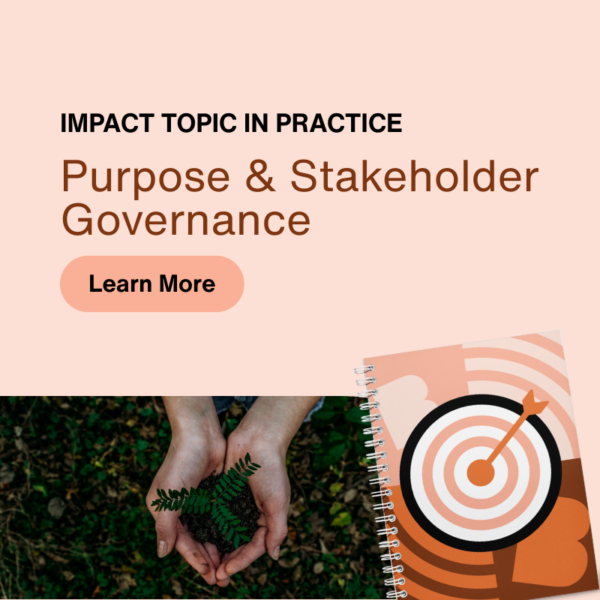
Purpose & Stakeholder Governance (PSG) Impact Topic in Practice
The Purpose & Stakeholder Governance Impact Topic supports B Lab’s goals to overturn shareholder primacy, put sustainability at the right level within the company, and fight greenwashing. This guide helps companies put the standards into practice.
The Grey Space Between Revenue and Values
One of the most persistent tensions in ethical business is not a lack of intent but the space between principle and practice. A partnership may be legally compliant, financially beneficial, and operationally efficient, while still raising legitimate questions about alignment with a company’s stated values. This is where ethical complexity lives.
Contracts are often treated as operational tools that are focused on deliverables, scope, and revenue. But they are also signals. They reflect priorities, trade-offs, and the types of relationships a company is willing to support.
In a transparent, highly connected marketplace, those signals are increasingly visible and increasingly interpreted through a values lens. For B Corps, this creates an ongoing responsibility not to eliminate complexity, but to navigate it with intention.
Digital Agency and B Corp Mightybytes, for example, considers individual projects and the ongoing relationship with each client separately. They even go as far as to draft up separate master service agreement (MSA) contracts for each.
“We created an education impact business model specifically to foster ongoing, shared learning throughout projects and in all our stakeholder relationships,” explains Mightybytes Founder and President Tim Frick. “To support this, we use separate documents to govern client relationships and project scopes. Both reflect our B Corp values, and each goes through a separate, collaborative revision process.”
This extra work allows the agency to control outcomes that may not necessarily be reflected in individual projects but which could emerge over time through the course of a business relationship. As a result, deeper, more-nuanced outcomes can be sought with intention.
Standards Are Evolving, but Judgment Still Matters
The B Lab standards have evolved in response to global input, regulatory shifts, and stakeholder expectations. Increasing emphasis on Purpose & Stakeholder Governance reinforces the idea that companies should consider the impact of their decisions on all stakeholders and not just shareholders.
But even as standards expand, they cannot fully define every scenario a business will face. That is where internal systems become essential, including supplier codes of conduct, ethical review processes, and cross-functional decision-making structures that all help companies evaluate not just financial or legal risk, but alignment with mission and values.
These systems matter because they shift ethical decision-making from reactive justification to proactive consideration. They also acknowledge a key reality that alignment is not always binary. Some decisions may move forward with mitigation strategies or ongoing evaluation rather than clear-cut approval or rejection.
A Shared Responsibility for Accountability

Accountability does not sit with one group alone. It is distributed across the ecosystem, including companies, employees, consumers, and communities who all play a role in shaping expectations around responsible business.
The B Corp model reflects this through both its certification standards and its public complaints mechanism, which allows stakeholders to raise concerns when they believe a company may not be meeting its commitments. But formal mechanisms are only one part of the equation.
Just as important is the informal, everyday practice of asking better questions early in the decision-making process:
- Who benefits from this partnership?
- Who could be indirectly impacted?
- Does this align with our stated commitments to equity, sustainability, or human rights?
- Would we feel comfortable explaining this decision publicly?
These questions don’t eliminate ambiguity, but they make it visible. And visibility is often the first step toward accountability.
Moving Forward by Taking a Closer Internal Look
There is no universal checklist for ethical partnerships. No single standard that can resolve every tension between values and revenue. But there is a growing expectation that companies engage more deeply with the implications of their decisions.
For B Corps, that expectation is part of the promise that business can be a force for good not only through direct action, but through the systems and partnerships it chooses to sustain. Because ultimately, impact is not only what a company creates but it is also what it enables.
We encourage companies to reflect on their partnership decisions, review their vetting processes, and continue engaging in open conversations about what ethical alignment looks like in practice and how accountability can be strengthened across every level of decision-making.
Sign Up for our B The Change Newsletter
Read stories on the B Corp Movement and people using business as a force for good. The B The Change Newsletter is sent weekly.