
New Year, Same Good: The B Corp Movement At a Crossroads
January 26, 2026
By Lauren Everett, Manager, Content & Digital Storytelling, B Lab U.S. & Canada
January has a way of inviting reinvention: new plans, new promises, new language for renewed intentions. In business, as in life, there’s a familiar pull toward the idea that a clean calendar can deliver a clean slate.
For those who are part of a global movement working to benefit people and the planet, January rarely offers a reset. The work carries forward, shaped by shifting social, political, and economic realities — along with the stakes that come with them.
Twenty years into the ever-evolving B Corp movement, and standing at the threshold of a new standards era, the global B Corp community finds itself at a rare crossroads: established enough to be held accountable, tested enough to carry legitimacy, and rooted enough to evolve without losing itself. At this threshold, the work ahead depends less on declaring answers and more on listening carefully — to the people, the pressures, and the responsibilities that now define the movement.
From Early Experiment to Global Infrastructure
B Corp Certification began two decades ago as an experiment: an effort to give form to a simple, demanding idea that businesses could be accountable to people and planet as a matter of practice. In the early years, companies found each other through personal networks and shared conviction. Founders gathered in living rooms and at conferences, building trust through direct relationship rather than formal governance.
Over time, that experiment expanded. Today, the B Corp movement includes more than 10,000 certified companies across 103 countries and 160 industries, collectively employing over one million people. This growth demonstrates resilience: the capacity to adapt across economic systems, regulatory environments, and business models while sustaining a shared commitment to accountability.
In those twenty years, the movement has been guided by a shared orientation toward continuous improvement, transparency, and responsibility. But as the community has grown, the surrounding context has become more demanding, bringing new expectations, pressures, and responsibilities into view. What once relied on direct connection now requires governance structures, verification systems, and standards that can operate consistently across vastly different contexts.
Accountability Under Pressure
The urgency facing values-led businesses today is not abstract. Across the globe, and particularly in the United States, companies committed to equity, environmental responsibility, and stakeholder governance are operating within political, cultural, and regulatory environments that are increasingly contested. In some contexts, long-standing commitments are being recast as liabilities rather than responsibilities.
Consider the pressure points: companies face legislative challenges to diversity initiatives, shareholder lawsuits questioning climate commitments, and regulatory uncertainty around ESG disclosure requirements. B Corps publishing pay equity data may face backlash in markets where such transparency is uncommon. Those setting science-based emissions targets navigate supply chains where partners face different regulatory regimes and economic constraints.
For the B Corp community, this terrain is familiar, even as its scale is new. From the beginning, the movement has operated with the understanding that responsibility carries cost, and that leadership often unfolds under constraint. What distinguishes this moment is the intersection of that reality with global reach and visibility. Meeting it requires standards and systems capable of managing tension without becoming rigid, and of supporting businesses as they translate values into practice under sustained scrutiny.
Listening as Governance: Evolving the Standards
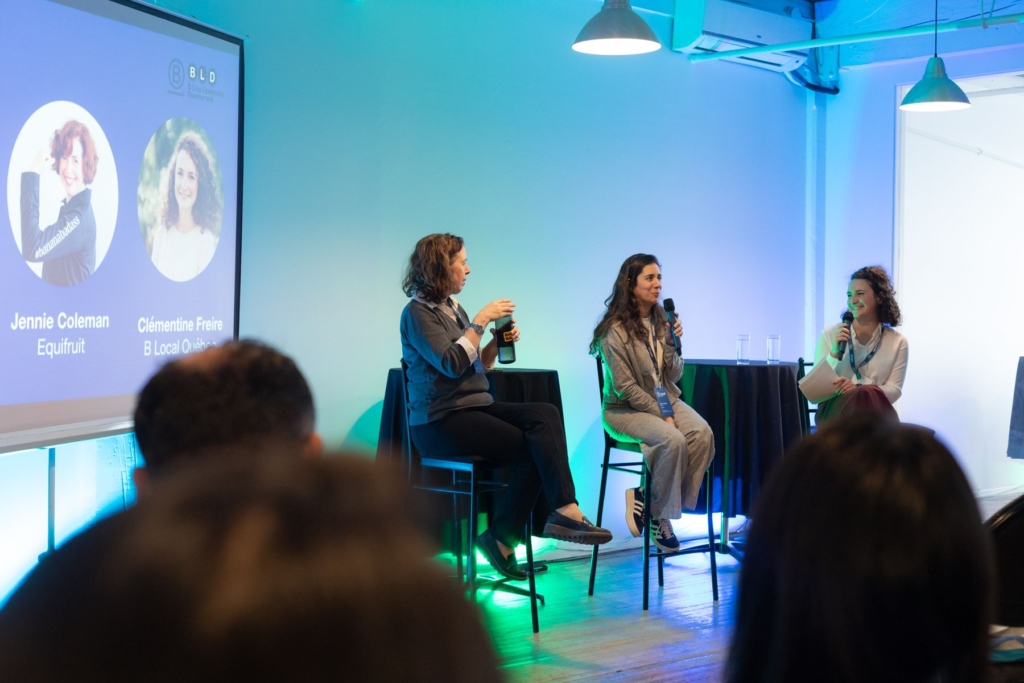
BLD Québec panel from Nov. 2025, featuring B Local Québec board member Clémentine Freire as moderator, Céline Juppeau, founder of Kotmo, and Jennie Coleman, President at Equifruit, in a conversation that revealed how companies can amplify impact across the supply chain.
One of the most consequential shifts in the evolution of the B Corp movement has been the recognition that listening is a form of governance.
Over the past several years, B Lab has engaged its global community in a sustained way, gathering more than 16,000 pieces of feedback from companies, workers, stakeholders, and experts across regions and industries. That input revealed where standards needed to stretch, where they required greater clarity, and where they needed to reflect the realities businesses face in practice.
What emerged from this process was substantive. Companies operating in regions with limited environmental infrastructure asked how to demonstrate climate commitment when renewable energy isn’t accessible. Small manufacturers questioned whether governance expectations built for knowledge work translated to shop floor realities. Worker-owned cooperatives surfaced tensions between collective ownership models and governance frameworks designed for traditional corporate structures.
This listening wasn’t conducted from a position of authority seeking validation, but from a posture of co-collaboration: building standards alongside the community they are meant to serve, with B Lab acting as steward rather than sole architect.
As a result, the movement’s core principles have been carried forward with greater precision. As conditions change, the standards have evolved in step, preserving accountability while remaining grounded in lived experience. Leadership emerges through participation rather than position — a dynamic that matters deeply at a time when trust in institutions is under strain.

Join Us for Champions Retreat 2026
Be part of the collective energy at the largest convening of B Corps in North America at Champions Retreat 2026, held April 21–23 in Milwaukee, Wisconsin. Find out more, and register for tickets here.
A New Baseline for Accountability
In the year ahead, companies will begin certifying and recertifying against B Lab Standards v2.1. These standards mark the most significant evolution since the movement began, establishing clearer baseline expectations for what responsible business requires in practice.
Raising the floor creates a shared foundation. It clarifies responsibilities across industries and regions, strengthens the credibility of certification, and reinforces accountability at a time when business claims face increased scrutiny from regulators, markets, and the public.
The updated standards introduce a structural shift in how impact is assessed. Moving away from cumulative point scoring, they establish baseline requirements across seven defined Impact Topics: Purpose & Stakeholder Governance; Climate Action; Human Rights; Fair Work; Environmental Stewardship & Circularity; Justice, Equity, Diversity & Inclusion; and Government Affairs & Collective Action. This signals that responsibility must be managed holistically rather than optimized in isolation. A tech company can’t achieve certification through strong governance alone if it neglects fair wage practices. A consumer brand can’t advance on environmental metrics while ignoring human rights impacts in its supply chain.
Alignment with global frameworks such as GRI, SBTi, and Fairtrade strengthens transparency and interoperability, giving companies a common language for managing impact across regulatory and operating environments. When a B Corp develops GHG emissions reduction plans aligned with limiting global warming to 1.5°C, that commitment serves certification requirements while also meeting investor expectations and regulatory disclosure frameworks emerging across jurisdictions.
Every certified B Corp is now expected to demonstrate year-over-year improvement across core impact areas, with flexibility in how progress is achieved based on size, sector, and geography. A 15-person studio in Nairobi and a 500-employee manufacturer in Wisconsin operate under different conditions, but both must show sustained, evidence-backed progress over time.
What It Means to Grow Responsibly
Growth increases visibility, accountability, and consequence. But it also expands what’s possible when responsibility scales alongside it.
More than one million people now work at Certified B Corps. That means fair work practices translate into lived conditions across manufacturing, food systems, technology, hospitality, finance, and sectors where wages, schedules, safety, and voice shape stability over time. At this scale, B Corps demonstrate that commitments like living wages, positive workplace cultures, professional development pathways, and worker participation in decision-making can be sustained as organizations grow.
Evidence from across the community shows consistent links between job quality and outcomes such as employee engagement and innovation, demonstrating that these practices shape not only fairness at work, but how organizations perform over time.
Defining the Next Generation of Leadership

When the B Corp community talks about the next generation of leadership, the definition is intentionally broad. It includes emerging leaders stepping into influence earlier, often with a more global and intersectional perspective. It also includes operators inside complex industries — manufacturing, logistics, agriculture — who translate values into systems that sustain at scale. It includes leaders working outside traditional centers of economic power, building the movement from new geographies and contexts.
What unites this generation is orientation rather than age or title: comfort with ambiguity, commitment to accountability, and an understanding that durable impact is built through collaboration rather than individual visibility.
As the movement enters its third decade, this posture matters. The challenges ahead — climate instability, social fragmentation, economic inequality — require coordinated effort, shared frameworks, and leadership willing to evolve alongside others.
That commitment becomes tangible when the community gathers. In 2026, the Champions Retreat will convene in Milwaukee, Wisconsin: a city shaped by industrial legacy, civic reinvention, and long-standing efforts to build shared prosperity. The location reflects the questions the movement is learning to navigate: how to honor history while adapting to change, how to build systems that withstand pressure, and how to anchor progress in real places and people.
Champions Retreat functions as a working forum for the movement: a place where leaders step out of organizational roles and into shared responsibility for what comes next. It creates space to surface tensions, test assumptions, and align on direction in ways that are difficult to achieve inside day-to-day operations. As the standards mature and the community expands across increasingly diverse contexts, this kind of collective work becomes essential to ensuring standards remain usable, legitimate, and lived.
The Work Ahead
Twenty years of B Corp Certification carries responsibility as much as it does reflection. The context has shifted. The community has grown. Expectations around accountability, transparency, and governance have intensified. What once relied on shared values and proximity now depends on systems that can operate with integrity at scale.
This moment matters because alignment can no longer be assumed. It must be built deliberately: through standards, through governance, and through collective stewardship of what the movement stands for as it evolves.
The next twenty years will not resemble the first twenty. They will unfold under different constraints, technologies, and social expectations. The movement’s strength lies in its responsiveness to changing conditions rather than adherence to a fixed moment in time.
As the community enters this next chapter — through updated standards, sustained listening, and collective reflection — it does so with clarity about what endures: standards governed independently, accountability that withstands pressure, and continuous improvement oriented toward shared benefit.
Community input will remain central as the movement continues to evolve. Tools like the Community Survey help surface how the work is being experienced across contexts, what’s holding, and what deserves deeper attention next. The goal isn’t resolution, but orientation, grounded in lived experience and built together.
The work continues. New year, same good.
—
B The Change gathers and shares the voices from within the movement of people using business as a force for good and the community of Certified B Corporations. The opinions expressed do not necessarily reflect those of the nonprofit B Lab.
Sign Up for our B The Change Newsletter
Read stories on the B Corp Movement and people using business as a force for good. The B The Change Newsletter is sent weekly.