Write Checks, Not Posts: How Social Enterprises Can Actually Move the Needle (Even in Today’s Environment)
February 6, 2026
By Rai-mon Nemar Barnes, Founder & CEO, Consciously®
It’s scary and frustrating out there. When trying to champion justice, equity, diversity, and inclusion (JEDI), countless people are being silenced. But there’s good news: making true progress doesn’t mean you have to be loud. It means you have to be there for people who need you when it counts. That’s the difference between noise and impact.
Because you know what’s louder than a tweet storm? A canceled check.
Black History Month gives us the opportunity to reflect on how we can make a difference right now, with actions mirroring difference-makers of the past (rather than empty words admiring them).
Take Herman J. Russell, the Atlanta, Georgia, construction magnate who quietly bankrolled the Civil Rights Movement. While others were figuring out “how to support,” Russell was sending bail money for Martin Luther King Jr. and turning his living room into strategy headquarters for desegregation efforts. No press releases. No hashtags. Just resources when they mattered most.
Or Georgia Gilmore, who started “The Club from Nowhere” during the Montgomery Bus Boycott. She and her crew of domestic workers turned fried chicken and pound cakes into hundreds of dollars a week for the movement—selling to Black and white customers, none the wiser about where their money was really going.
Here’s the thing: your social enterprise doesn’t need another LinkedIn post about your values. The world needs you to show up with actual resources.
What It Actually Looked Like: Real Examples of Quiet Support and Grassroots Hustle
There’s countless examples of times when being visible in bank accounts was more impactful than being visible on the daily news.
When the Montgomery Bus Boycott kicked off in 1955, not everyone could afford to be publicly involved. Many Black domestic workers cleaned houses and raised children for white families—families who would fire them in a heartbeat for supporting “agitators.”
Georgia Gilmore founded the Club from Nowhere, bringing together maids, service workers, and cooks to support the boycott while protecting members from retaliation. They sold fried chicken, pound cakes, and full dinners everywhere from church parking lots to beauty parlors, raising hundreds of dollars weekly.
The brilliance? White supporters could write checks to “The Club from Nowhere” without revealing the actual recipient, and members questioned about their money could truthfully say it came from selling food or from “Nowhere”.
At Monday night mass meetings, the Club presented large cash donations—often $100-$150—to standing ovations from the crowd. After she was fired for testifying in King’s defense, he encouraged her to start her own home restaurant, and the King family helped her buy kitchen equipment. Her home became a safe gathering space for movement leaders.
The lesson: Sometimes the most powerful infrastructure is baked into a pound cake.
Maggie Lena Walker: Building Economic Power Before Anyone Called It DEI
Fifty years before Rose Parks inspired us, Maggie Lena Walker led a citywide boycott against segregated streetcars in Richmond, Virginia, and in 1903 became the first African American woman to charter and serve as president of a bank.
At a time when white-owned banks refused deposits from Black customers, Walker’s St. Luke Penny Savings Bank had financed over 600 home and business loans for Black families by 1920. She also opened a department store and founded a newspaper where she served as managing editor.
Walker organized the first Richmond branch of the NAACP, promoted women’s suffrage, and led voter registration drives. Her vision was to create businesses that hired and served the Black community, believing firmly in supporting Black-owned enterprises.
The lesson: Real economic power isn’t a program—it’s infrastructure that outlasts you. (Her bank survived until 2005 as the longest-operating Black bank in U.S. history.)
Hosea Williams: From Bloody Sunday to Feed the Hungry
Most people know Hosea Williams from the iconic photo of Bloody Sunday—March 7, 1965—when he and John Lewis led over 600 marchers across the Edmund Pettus Bridge in Selma and were met with tear gas and billy clubs.
But after the cameras left? Williams kept showing up.
As Martin Luther King Jr.’s “chief lieutenant” and National Director of Voter Registration for the SCLC, Williams organized the Summer Community Organization and Political Education Project (SCOPE), which registered over three million new Black voters in 11 states. King called him his “bull in a china shop” and his “Castro.”
After King’s assassination in 1968, Williams didn’t retreat from politics full-time (though he served in the Georgia House, the Atlanta City Council, and the DeKalb County Commission). In 1971, he founded Hosea Feed the Hungry and Homeless—now Hosea Helps.
For nearly 50 years, the organization has provided hot meals, haircuts, clothing, and services to those in need on Thanksgiving, Christmas, MLK Day, and Easter. To date, they’ve donated billions of dollars worth of food and supplies.
The lesson: Real activism doesn’t end when the march is over. It shows up with a hot meal on Christmas.
Herman J. Russell: Money Talks, Press Releases Walk
Herman J. Russell, an Atlanta businessman specializing in construction and real estate, was also a leader and supporter of the Civil Rights movement in the South. He served on the boards of Citizens Trust Bank, Central Atlanta Progress, and the Business Council of Georgia. Behind the scenes, he used his profits to directly support the work of Dr. Martin Luther King and other Civil Rights organizers.
Russell’s home became a meeting place where civil rights leaders strategized about desegregating schools, building a new airport, and passing MARTA legislation. He provided bail money and financial backing when banks wouldn’t. While he did much more….sometimes it’s the simplest examples that can be the most powerful.
And by the way, he didn’t need or ask for credit. He needed change.
The lesson: Your conference room can be a war room. Are you using it?
Why the “Shut Up and Ship” Approach Actually Works Better
You can’t get canceled if you were never performing.
Remember when every company rushed to put out Black squares and DEI statements in 2020? Fast forward to today: anti-ESG sentiment has companies backtracking faster than you can say “quarterly earnings”.
Meanwhile, the folks who’ve been quietly writing checks for decades? Are still writing checks.
When you’re not performing activism, you can’t be accused of “virtue signaling.” You’re just… supporting the work. If your name is on every press release, you’re doing it wrong.
It’s true that actual survival sometimes requires discretion. During the civil rights era, NAACP supporters faced job loss, economic reprisal, and physical threats.
The Club from Nowhere protected its members through strategic anonymity. Recent trends show growing numbers of donors seeking anonymity due to social media’s ability to amplify criticism. Sometimes, keeping your head down keeps the work going.
When to Break Your Silence (Strategically)
Our ability to speak up can be vital. Sometimes, it’s literally a matter of life and death.
When your voice is needed, remember that it’ll often be during times when speaking up is an actual risk. But remember, too, that the goal is never to seek attention, but rather to direct it. The visibility you bring could be a difference-maker.
You should heed the call to amplify voices and use your own platform when:
- Your community partners directly ask you to do so
- When silence means being complicit, especially when direct attacks and injustices are happening in the “right now”
- When you’re sharing what works (rather than describing who you are; AKA, share the lessons, not the glory!)
The Uncomfortable Truth Section: Who Are You Actually Supporting?
Quiet corporate activism means picking your battles, reframing communications, and embedding values in how you do business. It also means paying attention to what folks are saying should matter the most.
Unfortunately, following these practices can be challenging for those operating purely in a PR mindset. They might not want to hear it because they’ve been taught to “show their work” so that it can generate returns for the business.
Making matters worse, they’re probably not funding the right people.
In 2016, only 0.6% of foundation giving was targeted to women of color. In 2019, $450 billion was donated to American philanthropy, but funding gaps between White-led and Black-led nonprofits remain massive.
Check your grantmaking. Check your supplier list. Check who’s at the decision-making table. If it’s all people who look like you, you’re part of the problem.
Sometimes folks get funded because of who they know, not what they know or how well their organizations perform. Networking matters, but make sure you’re using those networks to open doors, not to keep them closed.
Your brand is not the point. Your quarterly earnings call is not the point. Your founder’s TED talk is not the point.
Georgia Gilmore’s work symbolized the strength of the Black community and solidarity in the struggle for equality—not her personal brand.
What changed because you existed? That’s the only metric that matters.
Play the Long Game: Be an Ally, Not an Actor
Herman Russell exerted much of his influence behind the scenes, providing counsel and funding where needed. His home became a strategic meeting place for civil rights leaders. His legacy isn’t measured in press clippings—it’s measured in changed laws, built infrastructure, and expanded opportunity.
The most transformative support often happens in the spaces between press releases—in living rooms turned strategy sessions, in kitchens turned fundraising hubs, in banks that say yes when everyone else says no.
Here’s some action items that could get you going in the right direction:
- Audit your grantmaking/funding. Where’s the money going? Who’s making those decisions?
- Review your current partnerships. Are you supporting or performing?
- Ask three community organizations: “What do you actually need?” Then shut up and listen.
- Build relationships before the next crisis. Measure impact by community outcomes, not your press mentions Remember: The goal is change, not credit.
Your job isn’t to be the hero of the story. Your job is to make sure the story has a better ending.
Now go write some checks.
—
B The Change gathers and shares the voices from within the movement of people using business as a force for good and the community of Certified B Corporations. The opinions expressed do not necessarily reflect those of the nonprofit B Lab.
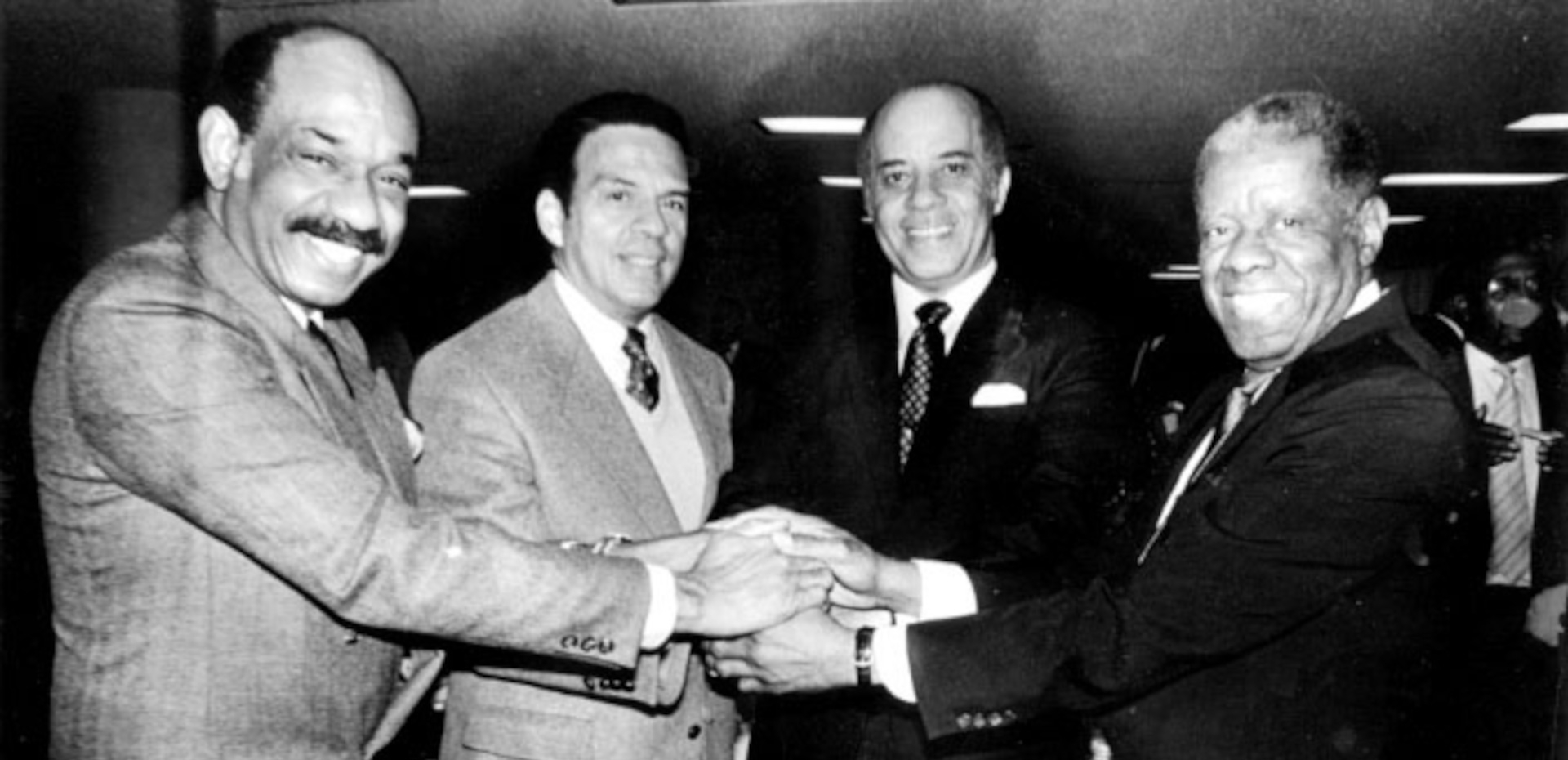
Banner image: Three prominent civil rights leaders from Atlanta gather in 1987 to endorse the candidacy of Richard Arrington Jr., who later won the election to become the first Black mayor of Birmingham, AL. From left, Herman J. Russell, Andrew Young, Richard Arrington, and Jesse Hill. Courtesy of Atlanta–Fulton Public Library System, Harmon Perry Photograph Collection.
Sign Up for our B The Change Newsletter
Read stories on the B Corp Movement and people using business as a force for good. The B The Change Newsletter is sent weekly.