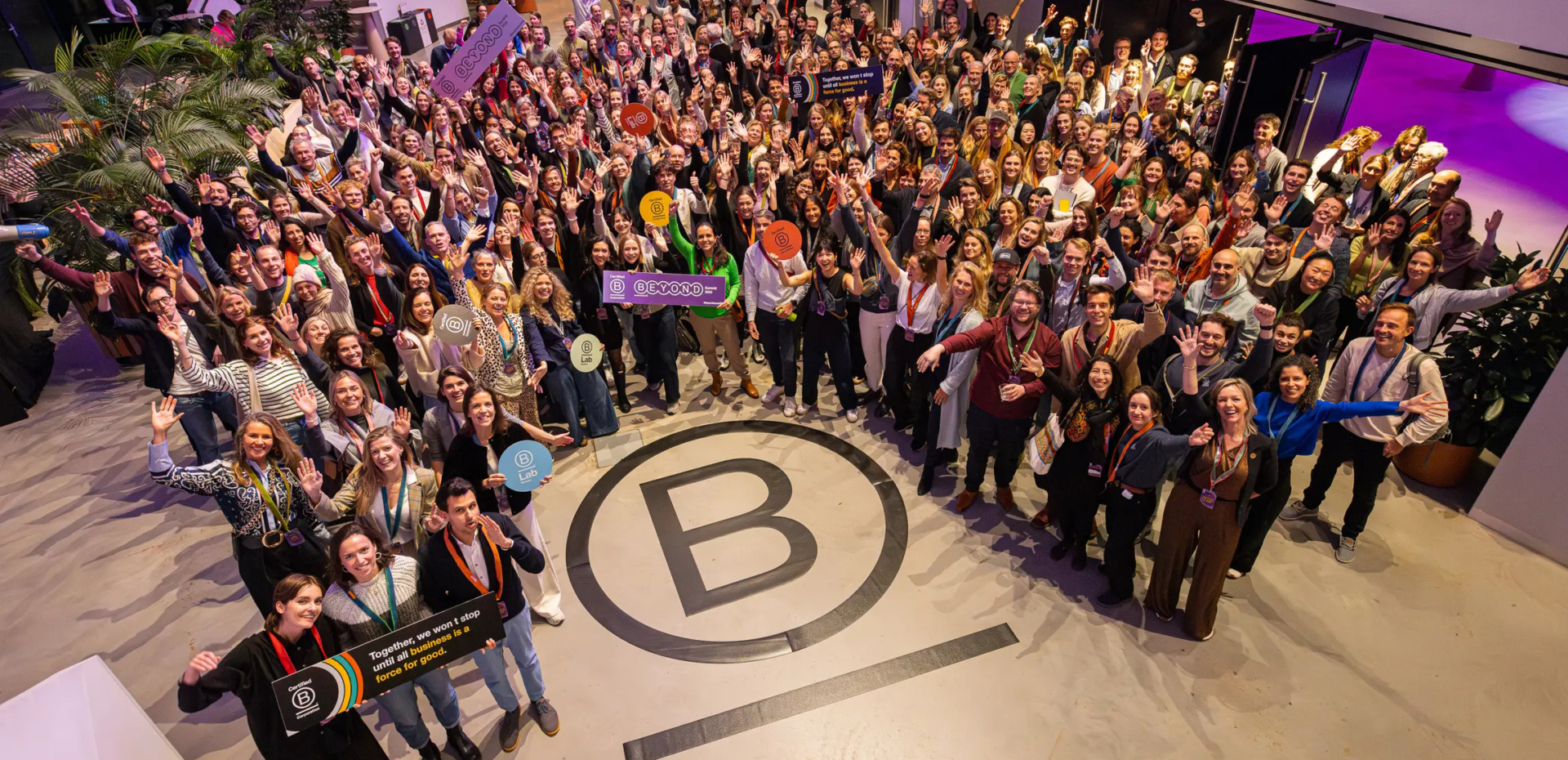
20 Years of the B Corp Movement, Part One: The Past
July 3, 2026
As B Lab™ celebrates its 20th year, we want to pause to reflect on how we got to this moment.
The Builders
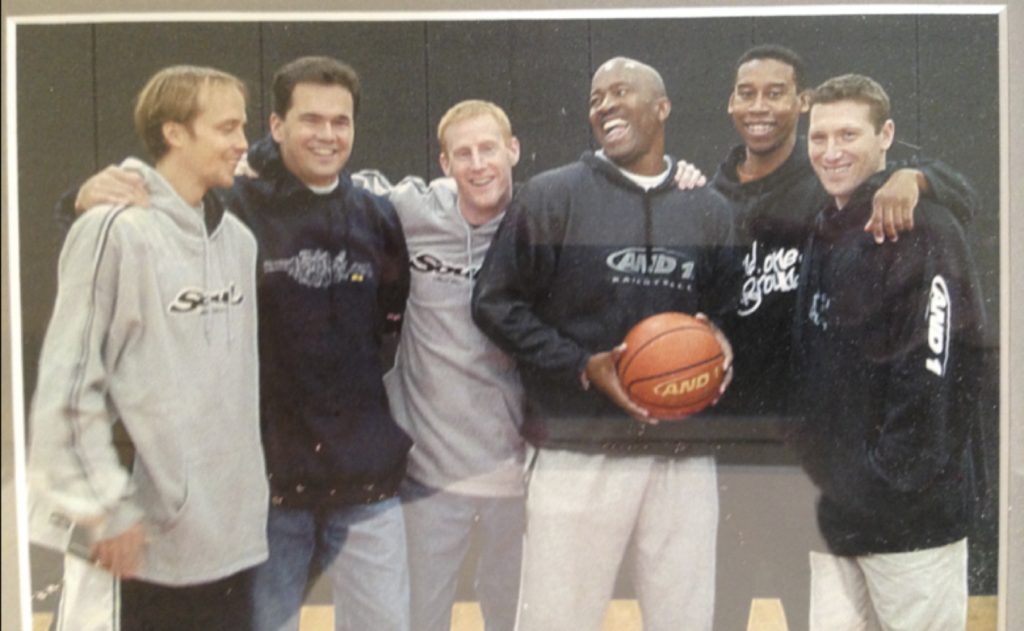
The AND1 partner team, ca. 2001. B Lab Founders Bart Houlahan and Jay Coen Gilbert pictured second and third in the lineup from the left, respectively.
When Bart Houlahan and Jay Coen Gilbert sold AND1 in 2005, they got to watch what can happen to a company’s conscience when its ownership changes. They’d built a basketball brand centered on fair labor practices, community giving, and benefits its workers could count on.
But none of that was written into the structure of the company, so new ownership was all it took to strip the values out. The lesson was sobering but clarifying: good intentions don’t survive a balance sheet unless something holds them in place.
So they set out to build the safeguard AND1 never had. In 2006, Houlahan and Coen Gilbert teamed up with Andrew Kassoy, a longtime friend who’d spent sixteen years in private equity.
Two operators and an investor were asking the same question: Could a business be measured on how it treats its workers, its community, and the planet with the same rigor it uses to measure profit? The idea that a company answered to anyone beyond its shareholders ran against the orthodoxy of the day. So they built what was missing: a way to measure how a business treats the people and places it touches, and a legal form to hold it there. This was the origin of B Lab.
Deciding What Makes a B Corp™
Elizabeth Killough of the UnTours Foundation captures what companies were initially after: “At UnTours, we didn’t need convincing that business could be a force for good, we needed a way to prove it. B Corp certification gave us that proof.”
The founders built two things. The first was an assessment that asked a company hundreds of questions about its impact and produced a score that couldn’t be gamed. The second made a company’s commitments binding: a legal form, the benefit corporation, that let it write those commitments into its own charter, so the next owner inherited the organization’s conscience along with the assets.
Maryland passed the first benefit corporation statute in 2010, giving the founders’ idea its first standing in law: a company could now bind its mission to its charter and have the courts backing it. More than forty jurisdictions would follow. The scaffold was now built to outlast the people standing on it.
Building a B Corp Revolution
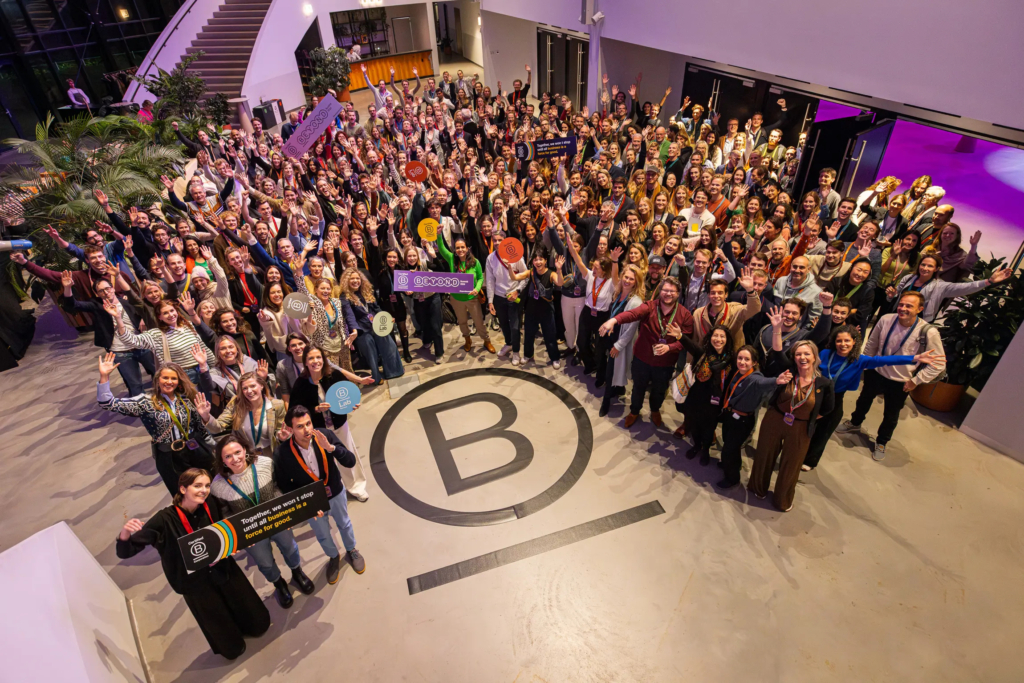
A group photo of attendees at B Lab Europe’s Beyond Summit 2024
Of course, a standard means nothing until an organization agrees to be held to it. In 2007, eighty-one companies did. Each signed a Declaration of Interdependence as it certified, and together they became the founding B Corporations.
The cohort included a flour company founded in 1790 and owned by its employees, a cleaning-products upstart, a clog maker, a yerba mate importer, and a café in Philadelphia. They were ordinary businesses, run by people who’d decided business could answer for more than it earned.
The name they signed under was an echo of the document signed in Philadelphia two centuries before, not far from where B Lab set up: interdependence as an answer to the Declaration of Independence.
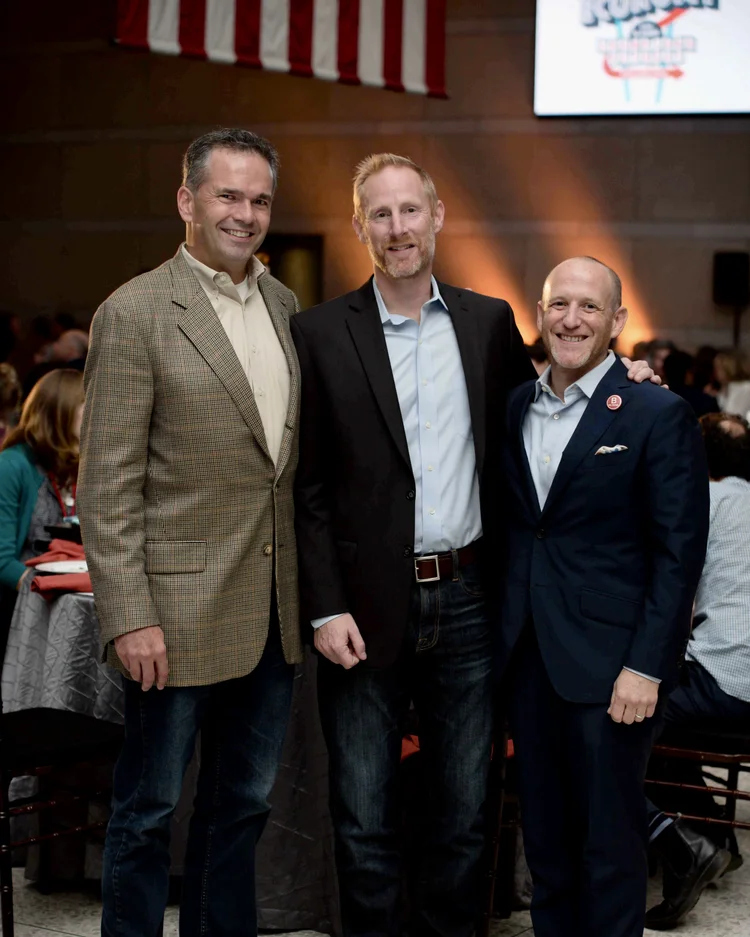
B Lab Founders pictured left to right: Bart Houlahan, Jay Coen Gilbert, and Andrew Kassoy
That word still holds the movement together. The Declaration asked the founding B Corporations to run their companies “as if people and place mattered,” and to act on the understanding that their choices rippled beyond their own walls. Every company certified since has signed it too, from the original eighty-one to today’s ten-thousand-and-counting. So when the 20th-anniversary campaign calls us interdependent since 2006, it’s reciting the founding document.
What that first cohort of companies started has only compounded. Among the founders still certified two decades on are Seventh Generation, BBMG, and King Arthur: proof that conscience and profit can share a P&L. The model crossed borders, industries, and company sizes until the question the founders asked stopped being radical and became the baseline.
This coalition has remained strong precisely because each member individually strives to reflect the movement’s foundational values. “In February 2008, Brand Geek signed the Declaration of Interdependence, and we’ve been B-vangelists ever since,” writes Lara Pearson, an attorney who operates Brand Geek, a B-Corp Certified legal practice that’s “committed to growing the impact of this movement.”
Lara expresses that one driving motivator is to be part of “a movement that is so much bigger than any one company, one that’s explicitly committed to justice and equality—a movement whose time may still be to come, as we recognize all the work to be done.”
That movement first crossed over into Canada in 2012, when Green Living Enterprises became one of the country’s founding B Corps. Its founder, Laurie Simmonds, had been making the market case for. years: “We launched Green Living Enterprises in 1999 with a simple belief: consumers vote with their dollars. Becoming a founding Canadian B Corp was a natural extension of what we had championed from the beginning: that business can be a force for good.”
Ask the companies that stayed what kept them, and many name the community. Bryan Miller of BBMG, one of the original eighty-one, remembers when the logo carried none of the weight it does now: “We’ve been a B Corp since the beginning, when the logo meant little to anyone outside the room. What’s kept it meaningful for us is the community: the people who won’t let us settle for saying the right things and who expect us to actually live them.”
Remembering a Builder We Lost
Just shy of B Lab’s milestone anniversary, the B Corp community lost a fellow builder and leader, Andrew Kassoy, who died of a two-year battle with cancer in 2025. He’d built his career inside the machine he ultimately set out to change, and after the September 11th attacks, he went looking for another way to use capital.
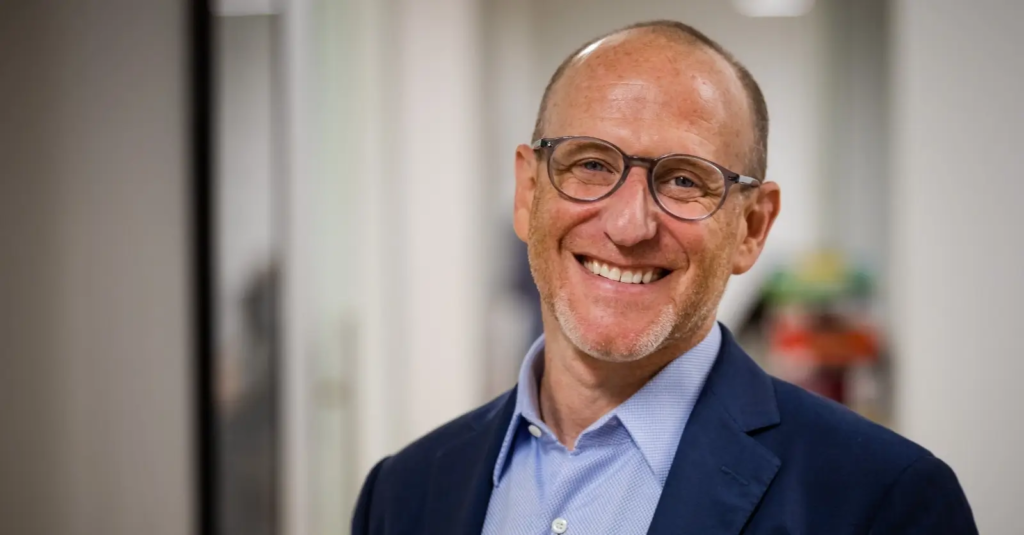
Late B Lab Co-Founder Andrew Kassoy
Andrew believed the work had to be done with what he called “a duty of care,” and he meant that phrase as a caution as much as a value: that it was possible to win the argument for a new economy and still build it as carelessly as the old one if you weren’t deliberate about how.
“Our job, all of us, is to weaken the mighty walls of resistance to a new system,” he claimed. “In a time when so many people are careless, and so many people lack moral courage, it’s up to us to double down on care and courage. And that’s a hell of a lot easier, and a hell of a lot more powerful, if we do it together.”
Later this year, B Lab will launch the Andrew Kassoy Award for Collective Action to carry that conviction forward.
From Modest Beginnings to the Build-up of a Global B Corp Movement
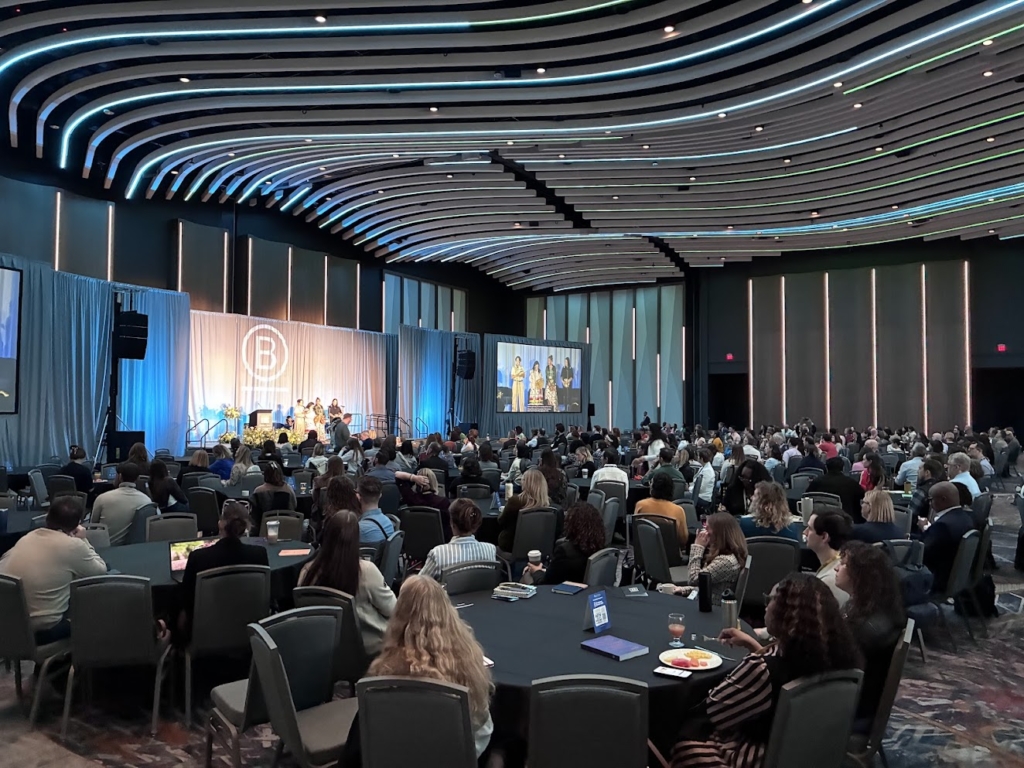
Attendees at Champions Retreat 2026 in Milwaukee
Twenty years on, the founders’ initial question about how to measure a company’s impact has an answer they couldn’t have foreseen in 2006.
More than 10,000 B Corporations now exist across more than 100 countries, collectively employing more than one million workers. And the principle that business should answer to more than its shareholders is written into law in more than fifty jurisdictions. The scaffold held.
What the builders put up was never meant to be theirs to keep. It was meant to bear the weight of everyone who came after them. Two decades on, it still does.
Sign Up for our B The Change Newsletter
Read stories on the B Corp Movement and people using business as a force for good. The B The Change Newsletter is sent weekly.