
How Our TrailBlazers Incorporated B Lab™ Standards V2 Across Their Company
November 9, 2026
In our years of working with B Corps™, what we commonly see is that a single person or a small team is responsible for managing and maintaining certification. They know the deadlines, keep track of the requirements, and follow up when a response is needed. They may also find themselves trying to answer questions about hiring, suppliers, climate, governance, and public policy—sometimes all before lunch.
But this is often too much for one person to bear, especially in light of the increasing responsibilities expected under B Lab™ Standards V2.
“I cannot be an expert in every one of these categories,” said a member of our TrailBlazers cohort of companies preparing to recertify under the new standards. “Trying to do that is just silly,”.
That tension surfaced again and again amongst our TrailBlazers. Yes, a point person can hold the process together, while an executive sponsor can help make time and resources available. But some of the most useful conversations happened with the people whose job duties actually affected compliance. Those people knew what was happening, where the documentation lived, who could make a decision, and whether a proposed change would work in practice.
For companies of all sizes, maintaining B Corp certification under B Lab Standards V2 means integrating policies and processes across nearly every department. That requires a team lift.
In light of this, one of the biggest priorities for our TrailBlazers was discovering how to bring others onto their team. Here’s what they learned.
Review Responsibilities to Put Ownership in the Right Hands
The B Lab Standards V2 heighten the importance of conversations about who will own each aspect of building systems and meeting requirements. Previous versions of the Assessment asked about the whole company, but companies could qualify for certification by earning enough points across a few individual impact areas. Now, companies must meet baseline requirements across every impact topic. A strong showing in one area cannot stand in for a gap in another.
The new requirements also call for different kinds of work. A company may need a policy, a way to collect data, a strategy with defined targets, a review by its highest governing body, and a public account of its progress.
Those pieces can rarely be put together by one—or even a few—individuals. The responsibilities inevitably touch on the work done in other roles. A sustainability lead might coordinate a strategy, for example, while operations supplies data, legal helps draft a policy, leadership approves a plan, and communications helps make the results public.
To connect these elements, B Lab now requires companies to operate a Sustainability Management System so these activities can continue naturally as part of how the company operates.
For the person leading certification or recertification in a large company, that can mean building a fairly long list of names, including their own.
Donna Fugaro from TrailBlazer company Humanscale looked at her company’s gap analysis and “saw a lot of my name on there” for both one-time tasks and ongoing responsibilities. It is an understandable first pass: when no one else has been assigned a requirement, it stays with the person holding the spreadsheet. But it’s generally not realistic, especially for larger companies.
Find Touchpoints Between Existing Job Roles and Certification Requirements to See Who Should Own What

In the Trailblazers Program, participants were asked to review job roles from across their company to understand where requirements connected to each person’s work.
A colleague could tell us that a policy existed but was applied differently across locations. Another could identify who had the authority to approve a change. Someone else could explain why a sensible-looking plan would be difficult to carry out. Those details led to easier and more accurate assessments of what was needed for compliance and where gaps may exist.
When acting on this information, companies should bring in the people who will be directly involved in helping clear the gap. To find them, look for places where job roles and B Corp certification requirements intersect. Allow these individuals to review and respond to the gap analysis directly. Opening up these conversations from the start will inform strategies, surface opportunities, help define clear goals, establish accountability, and bring everyone into alignment.
One thing to keep in mind is that these key individuals will remain involved long after the first recertification submission. In Years 3 and 5, colleagues across the company might be asked to update plans, provide new data, explain what has changed, and document the results. At larger companies, some job roles might also provide evidence or answer questions during annual audit reviews.
Bringing these people in at Year 0 gives them a chance to understand the requirements connected to their work and establish ways to keep records and track progress over time. It also gives them a chance to make the standards useful in their own departments.
Without that involvement, certification or recertification can feel like “an interruption,” observed Rebecca Coffey of Impact Growth Partners, a B Corp consultant and guide for our TrailBlazers.
Consider a procurement team reviewing a human rights requirement. If they are involved early, they might look more deeply into labor practices as part of the questions they already ask when approving a supplier. They can also use the answers they get when making compliant decisions, and follow up on whether expectations were being met during usual supplier reviews.
In other words, the team doing the work can see where each requirement is involved within an existing process. Asking them to do so after the fact can be a monumental task rather than a follow-up on an expectation that was established earlier. B Lab’s Interoperability notes can help them see where that same work aligns with other impact frameworks the company uses.
What Spreading Ownership Around Looked Like for Our TrailBlazers
The TrailBlazers found different ways to bring people into the process of assigning accountability and ownership.
Burton used its gap analysis to connect requirements to owners, policies, targets, and governing body oversight.
One TrailBlazer company, a vitamins and supplements purveyor, worked across three continents, with regional teams gathering their own data using a method first tested in Europe, the Middle East and Africa (EMEA). Its Global Director joked that “the Belgians are always eager to be prepared.”
At one TrailBlazer company, a home-delivered beef subscription service, the team encountered technical obstacles that required rethinking where documentation and collaboration took place. Moving its IGP Impact Tracker from Google to Microsoft made it easier for teams to take part.
None of these companies organized the work in exactly the same way. What they had in common was that they all found a way to build clearer connections between each requirement and the people with the knowledge, authority, or responsibility to address it. The team may look completely different depending on the company, with different job titles at each.
Making room for those people takes leadership support.
One TrailBlazer participant, who represented a purpose-driven international shoe company, described differing views about both the importance of recertification and the effort it would require.
A TrailBlazer participant that offered organic skincare products said the owners believed in the work, while recognizing that “this isn’t work that we can do off the side of someone’s desk.” It’s a simple question of capacity, even when everyone agrees the work matters.
“There’s no way for this to be bolt-on. It’s just not possible,” said Sonia Tze Huse of Impact Growth Partners.
A B Corp Certification Applies to the Whole Company, and So Does the Work It Requires
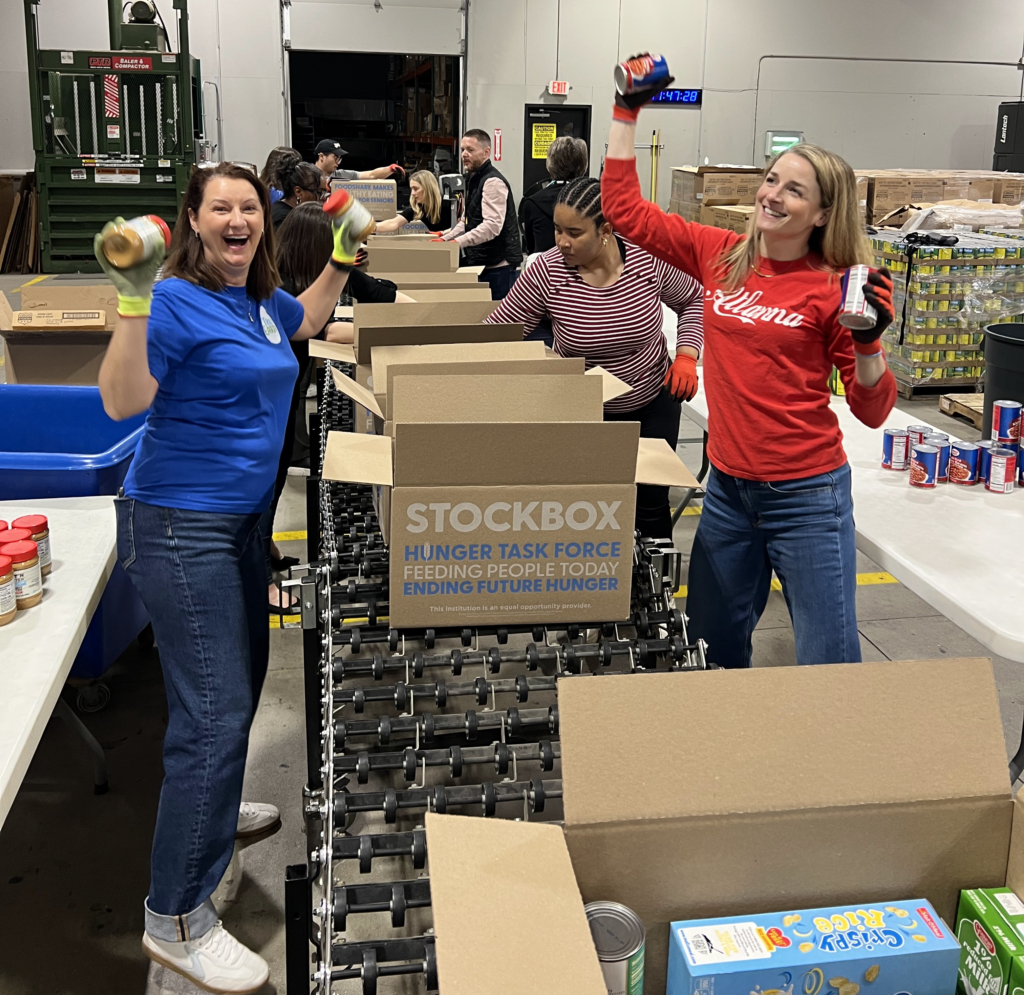
Champions Retreat 2026 attendees participate in a group volunteer event packing boxes for Milwaukee’s Hunger Task Force food bank (Photo: Shani Tucker)
The TrailBlazers showed us exactly why maintaining B Corp certification has to involve a team effort. A point person can bring the work together, and an executive sponsor can give it backing, but these two can’t carry certification on their own.
Involving the people who make decisions and do the work not only makes certification easier to maintain, but it also gives those in key roles a hand in shaping what happens next, both now and in the years that follow.
Shared ownership keeps sustainability inside every decision the company makes, the outcome that all B Corps are truly after. Build accountability across job roles in every department, and recertification is no longer a job that one person’s work can make or break.
Instead, it’s something the company does as a function of its everyday work, striving to benefit people and the planet through the regular course of business. And that’s really what being a B Corp is all about.
Want to see what your company would need to achieve to recertify under B Lab Standards V2? Take the Assessment in B Impact to get started.
Sign Up for our B The Change Newsletter
Read stories on the B Corp Movement and people using business as a force for good. The B The Change Newsletter is sent weekly.