
You’re Further Along With Certifying on B Lab™ Standards V2 Than You Think (Tales From Our TrailBlazers, Pt. 6)
November 19, 2026
B Lab™’s Trailblazers Program recently brought together eight companies to recertify under B Lab Standards (V2). The most common finding across all eight participants was also the most encouraging: companies are already doing much of the work the standards ask for.
Commonly, the only thing missing was a paper trail. A typical company had to take the practices it already engaged in and write them down, documenting all their policies, strategies, and processes. They then needed evidence that the highest governing body had approved them.
As our TrailBlazers uncovered, for many companies, the gap between current practices and meeting the new requirements is smaller than it looks. Closing that gap often means making existing work official while finishing the job for requirements that have been partially met.
The Most Common Gaps in B Corps™ Certifying on V2 Standards
Rebecca Coffey, a facilitator for our TrailBlazers cohort and one of the senior consultants with Impact Growth Partners (IGP), described three kinds of gaps she tends to see across companies.
Some practices are already in place but not written down. For example, a company could be lobbying responsibly without a documented responsible-lobbying policy to prove it.
Some practices are done in part. A company has a purpose statement, for instance, but it isn’t publicly disclosed yet. Or, it may track its own waste but can’t yet say where that waste goes after pickup.
And some gaps surface only once a company starts documenting. One TrailBlazers participant had been exercising due diligence to protect human rights within its supply chain, for example, but hadn’t yet pulled all that work into a single documented assessment.
In this way, these standards act like a stress test of a company’s management system. It shows what’s documented and where extra development, process integration, or proof-of-work is needed.
Most Companies Lacked Official Sign-Off on Impact Practices
Of the common gaps that surfaced, the most prominent was that companies typically didn’t get approval from their highest-governing body for impact-related work and objectives. Across the cohort, only about 14% of the impact actions they performed were signed off on by a high-ranking official or board.
So what about the remaining 86%? Companies quickly discovered that addressing it wasn’t as big of a leap as it initially appeared. For one, most impact teams weren’t resistant to highest-governing-body involvement. Indeed, many were glad to bring that body closer to their daily work and decisions.
Impact teams in the cohort often operated on the assumption that the bulk of this work wasn’t something senior-level bodies would be directly concerned with. Dispelling that notion was part of the motivation for B Lab Standards V2 to require these bodies to sanction these decisions: this work is important, and it is central to the company’s operations and mission.

Closing the gap in approval must start with identifying who would technically be the company’s highest governing body. This, of course, differs by company. In some organizations, it’s a single person, like the owner or CEO. In others, it’s a board or committee.
Naming that body is the first step in linking accountability for social and environmental standards. Every proposed action, policy, and process needs their approval, and each sign-off must be documented. Nothing is ignored or assumed. All of it is reviewed and sanctioned by the people at the top, the ones actively guiding the company’s mission and operations.
That may sound like a lot of work, but it doesn’t have to be. There’s no need to have the highest-level body read into the minutia or weigh in on every new decision. Approval can be consolidated into one review, with everything that requires sign-off going into a single packet.
These approvals can also be batched by need, scope, and time frame. Companies can keep the language generalized to make room for adjustments or expansions while still working under approved goals, practices, and procedures. Impact teams can also resubmit updated packets periodically to keep the highest-level body informed and up-to-date with any significant changes. These approaches make approval more manageable and intuitive, rather than feeling like a cumbersome process with unending repetition.
Putting the Four Parts of a Sustainability Management System in Place
Getting approval from the highest governing body is one of four possible parts of officially designating practices as part of B Lab Standards V2. The gold standard is to achieve all four:
- Each practice is written down, whether it involves a policy, a recurring assessment, a required procedure, a measurable target, or an overall impact strategy.
- A named person is accountable for the practice.
- The practice has been reviewed and approved by the highest governing body, with evidence that this occurred, such as having the approval reflected in minutes or within a signed document.
- The practice is publicly disclosed (when the standard requires it), preferably after the highest governing body has approved it.
Note that these four criteria may not apply to every single practice, depending on the related impact topic requirements and other criteria like the company’s size. However, most practices will invoke multiple requirements. Many will necessitate all four.
Having these elements in place (as required) forms the backbone of what we refer to as a “Sustainability Management System,” or SMS.
Putting the four elements of an SMS into action is usually closer at hand than it looks. For example, one internal practice at a large, multinational TrailBlazer participant is to never ask job applicants for their wage histories. However, that practice wasn’t formally written down as an official policy. Most gaps can be closed the same way: by documenting what a company already does.
“100% doesn’t mean perfect. You get lots of credit for showing your work,” explains Sonia Tze Huse, another IGP consultant and cohort leader.
Getting approval is typically the biggest lift of the four. It’s also something companies often think they have, but don’t. The highest governing body may have seen and OK’d a policy, but without minutes or a signature to show it, an assurance provider can’t credit the approval.
As Rebecca said of this requirement, most companies “step over it.” Undergoing it formally turns what a company already does into something it can demonstrate as part of its governance and operations.
Why Recertification Is Worth the Work
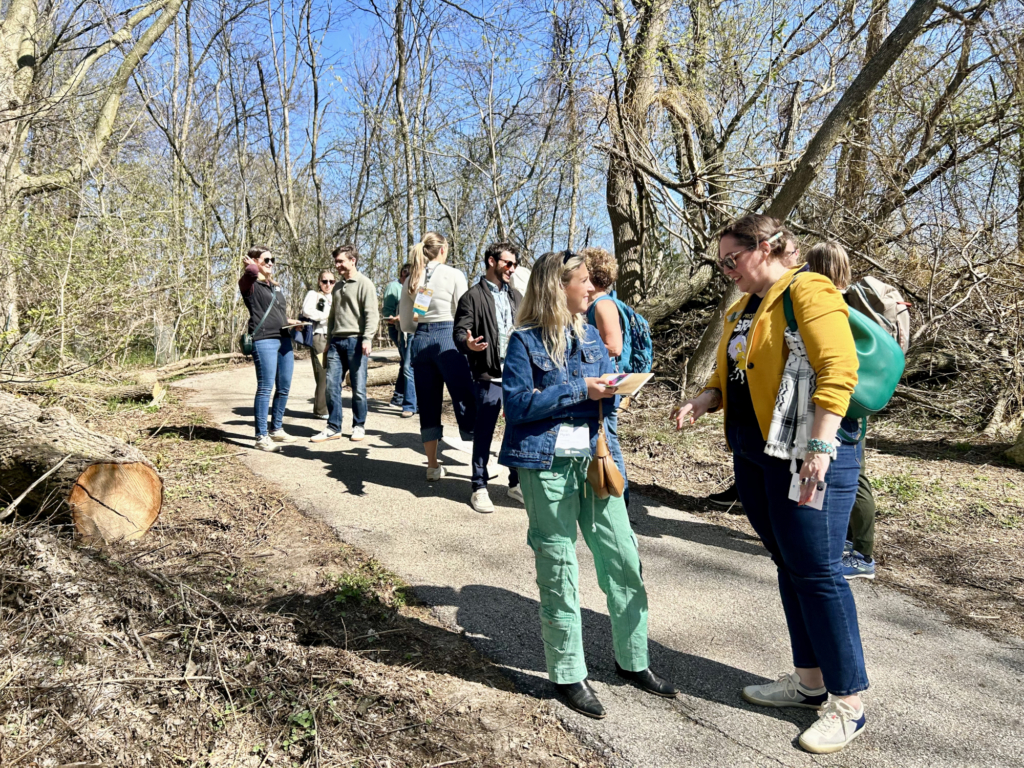
Champions Retreat 2026 attendees participate in the Milwaukee Riverkeeper Community Cleanup, collectively earning a Guinness World Record for their efforts (Photo: Thomas Bourne
The new standards reward companies that make their own practices evident: to the highest governing body, to the public (when disclosure is required), and to an assurance provider looking for evidence and official documentation.
For most of our TrailBlazers cohort, the bulk of their work involved taking their existing system and asking it to bear more of a structural load, documenting what they already do while making plans to address what still needs to be done. That’s a stress test worth running!
B Corp Certification shows that a company’s impact is verified and its governance accountable. The documentation, ownership, approval, and disclosure behind each practice serve as the proof. That’s how companies earn the B mark: taking the extra steps, putting everything into writing, and integrating accountability from the top down.
Companies can get started with their own Assessment in B Impact to understand how they’re already meeting B Lab Standards V2 and where their current practices (or perhaps documenting actions) could improve.
Want to hear more insights our TrailBlazers uncovered to make recertification easier to achieve under B Lab Standards V2? Visit our TrailBlazers overview and article hub for the full rundown.
Sign Up for our B The Change Newsletter
Read stories on the B Corp Movement and people using business as a force for good. The B The Change Newsletter is sent weekly.